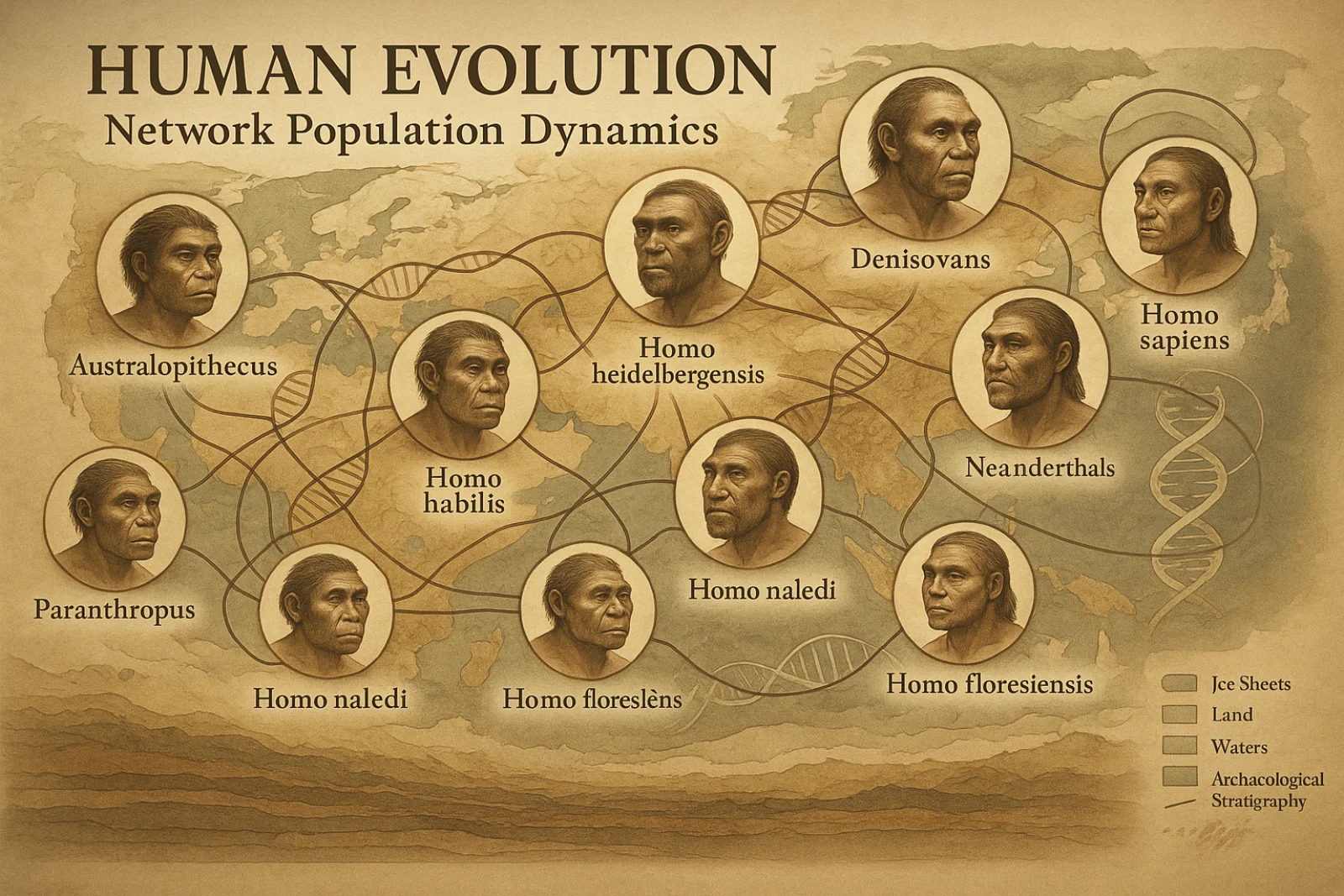
The starting assumption being questioned
Most accounts of human evolution are built on branching, hierarchical trees: populations split, diverge, and are traced back to a single point of origin. Network Population Dynamics (NPD) starts from a different question — what happens if that tree-based assumption is not applied at all, and population relationships are instead inferred directly from the data?
Method
Using machine learning models trained without a preset evolutionary framework, population relationships were modelled directly from genetic and morphological data, rather than being fitted to a tree structure in advance. The resulting analysis found that a large share of trait variation — by this analysis, around 94% — was better explained by stable, long-persisting population-network clusters than by branching lineage. Traits in this model tend to persist across networks rather than disappearing or reverting, and tree-based classification approaches performed comparatively poorly against the data.
This is a stated finding of an independent, not-yet-peer-reviewed analysis. It should be treated as a result to be tested and checked, not as a settled conclusion.
What "network, not tree" means
Rather than a small number of founding populations branching outward over time, NPD models human diversity as a web of long-standing, interconnected population networks — communities that exchange people, traits and culture over very long periods while maintaining distinct, stable characteristics. Diversity, on this model, is less a record of recent divergence and more a signature of deep, ongoing network structure.
Where this could matter
If a network-based model holds up under scrutiny, it has implications beyond human origins: for how population-specific patterns are understood in evolutionary biology, how cultural diffusion is mapped in anthropology, and how language persistence is traced in linguistics. None of that is established yet — it is the reason this work is being prepared for proper peer review rather than presented as finished science.
Next steps
The current research is being prepared for independent publication, with the methodology, data sources and assumptions documented openly so they can be checked. Progress and the underlying essays are published at the Originum Journal ↗.
Origin of the method
The analytical approach used in this research — structured, assumption-checking questioning supported by AI — originated in earlier work on Ask Lindy, an AI-assisted thinking-methods application. Originum is an independent research project, separate from that product.